
Renewable energy SCADA resources and case studies
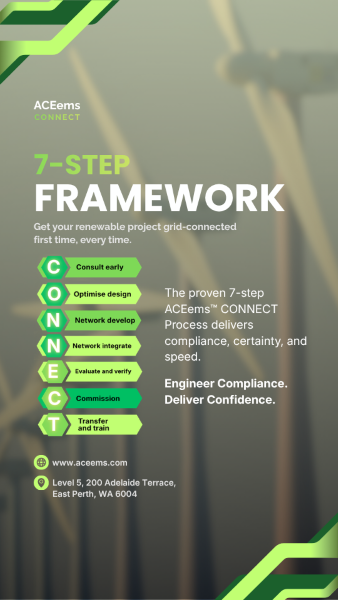
7-Step Framework

Capability Statement
Readiness Assessment
Audit Kit
Checklist

Special Report
Brochure
Capability Statement
Readiness Assessment
Audit Kit
Checklist

Special Report
Case studies and videos
Wagerup BESS: SCADA integration in practice
ACE integrated a 100 MW / 200 MWh battery energy storage system with redundant SCADA servers, PLC controls and a ring network. Battery equipment, inverters, switchgear and supporting systems were brought into a central operator environment.
When vendor hardware was unavailable for factory testing, DNP3 and Modbus simulators and PLC simulation logic helped verify data mapping, alarms and equipment displays before site commissioning.
Read the Wagerup BESS case study and request the full PDF.
What should we prepare before a SCADA design review?
Bring the current single-line diagram, equipment list, network requirements, communications architecture and available vendor signal lists. Identify the project stage, target commissioning date and responsibility for each interface. Request a project review.
What can factory testing check before equipment arrives?
Where suitable simulators are available, FAT can check signal mapping, scaling, alarms, command responses and agreed failure scenarios. Simulated testing helps find integration issues early; it does not replace checks on the installed equipment or site acceptance testing.
Does SCADA testing provide grid approval?
No. SCADA testing provides evidence for its agreed scope. Network approval, generator performance obligations, independent protection and approved operating limits require their own responsibilities and verification. See how testing fits into the ACEems delivery process.
The BESS Planning Mistake That Cost Millions
SCADA is consistently the last thing planned, and the first thing that causes costly delays.
A SCADA Configuration Gap That Made History
In 2021, a battery energy storage system (BESS), the Victoria Big Battery in Australia, caught fire.
Why SCADA is Your Most Critical Safety System
Battery energy storage is a safe technology when it's done correctly.
SCADA: Powering System Integration
SCADA is the central nervous system of a renewable energy project.
SCADA Fails Slowly. Losses Don't.
When SCADA is under engineered or fragmented, operators lose visibility and control.
Why SCADA Becomes a Project Blind Spot
SCADA failures rarely present as technical events, but rather commercial consequences.
How to Optimise SCADA Design for a Trouble-Free Grid Connection
One thing is important for every renewable energy project: getting connected to the grid – first time, with zero surprises.
What Happens When Grid-Connection Issues Are Found Too Late
Late-stage grid-connection issues can cause costly delays, rework, and even damage investor confidence.
Which Grid-Connection Audit Does Your Project Actually Need?
Not every renewable project needs a full audit, but every project needs one that fits its stage.
Future-Proof Your Project With Compliance Handover
After commissioning, ACE ensures a smooth transition with a complete compliance handover.
First Time Grid Success: The Value EPCs Demand
Leading EPCs value the ACEems CONNECT process because it eliminates uncertainty and protects project outcomes.
Engineered Certainty: Commissioning Done Right Every Time
We align compliance, control expectations, and grid requirements from day one.
Why Integration Errors Lead to Grid Connection Failure
If systems don't communicate seamlessly, grid connection fails.
Why Early Verification Ensures First-Time Grid Success
The ‘Evaluate & Verify’ step is critical for ensuring seamless grid connection.
Engineered Certainty: Commissioning Done Right Every Time
ACE delivers first-time-right commissioning by engineering certainty into every stage of the project.
Build Compliance Architecture Early for Grid Success
At ACE, we don’t guess compliance. We engineer it.
Is Your Renewable Project Truly Grid Connection Ready?
Take the Grid Connection Readiness Assessment to see where your project stands.
Grid Connection Failures
Mitigate the chances of grid connection failure through the ACEems™ CONNECT Framework.
Why Renewable Energy Projects Still Fail at Grid Connection
Getting a renewable project connected to the grid shouldn't feel like guesswork, but for many developers, it still does.
The Renewable Risk No One Talks About
ACEems™ CONNECT delivers predictable, low-risk grid integration for renewable energy sites.
The 7-Step Renewable Grid Connection Method EPCs Trust
The 7 steps of the ACEems™ CONNECT Framework.
ACEems™ CONNECT: Your Path to Grid Confidence
Seamless grid connection for renewable projects through engineered SCADA compliance solutions.
Align AEMO and TNSPs Before Design Begins
Early consultation is the key to avoiding costly grid connection delays.
Turning Design into Reality: Network Development Stage
What happens in the 'Network Development' stage?

QUICK LINKS
CONTACT US
Level 5, 200 Adelaide Terrace, East Perth, WA 6004
LEGAL