Our renewable energy SCADA delivery process
ACEems™
CONNECT Framework
ACEems™ CONNECT is Australian Control Engineering’s seven-step approach to renewable energy SCADA delivery for solar, wind and battery energy storage projects.
We start by agreeing the scope: plant and network interfaces, signal ownership, operating modes, remote commands, communications and evidence required for acceptance. This helps identify gaps before equipment configuration and site mobilisation.
Typical agreed deliverables include architecture drawings, an interface and signal register, a control philosophy, test procedures and results, configuration backups, operator training and handover records. The exact scope is defined for each project.
Network approval, generation performance studies, protection design and equipment certification remain with the parties appointed for those tasks. ACE’s SCADA integration work supports the agreed connection requirements; it does not replace independent protection or guarantee approval.
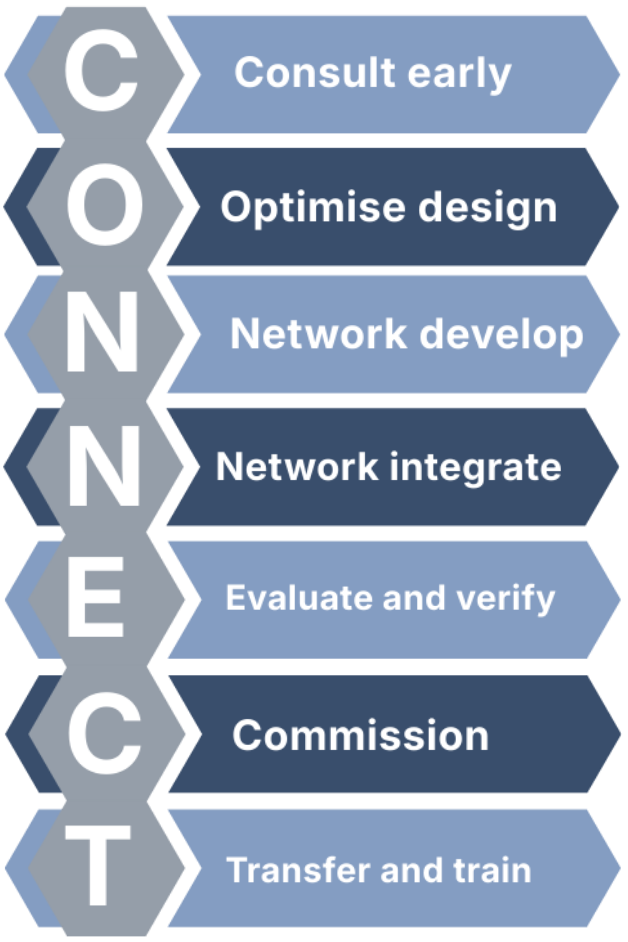
C - Consult Early
Objective: Identify SCADA requirements before detailed design.
Approach: Review available network requirements, vendor signal lists, plant operating modes and the project programme with the EPC and asset owner. Assign responsibility for each interface and record assumptions requiring resolution.
Deliverables: An agreed scope, interface register and action list that help reduce late design changes.
O - Optimise Design
Objective: Define a practical control and communications architecture.
Approach: Document signal paths, network boundaries, remote commands, time synchronisation and redundancy requirements. Coordinate with the appointed parties responsible for network connection and protection.
Deliverables: Architecture drawings, a control philosophy and signal schedules for review before configuration.
N - Network Develop
Objective: Develop and configure all control logic, communication protocols, and SCADA data structures.
Approach: Program PLCs, RTUs, and communication interfaces in alignment with the engineered design.
Outcome: A functional foundation prepared for full integration and validation.
N - Network Integrate
Objective: Integrate all control, communication, and monitoring systems into a unified, secure network.
Approach: Build, configure, and validate PLC, RTU, SCADA, and telemetry components to operate as one coherent system.
Outcome: A fully interoperable platform engineered for performance, reliability, and compliance.
E - Evaluate and Verify
Objective: Find integration problems before site commissioning.
Approach: Use agreed factory acceptance tests (FAT) to check signal mapping, scaling, alarms, command handling and failure responses. Where appropriate, simulators exercise interfaces before vendor hardware is available.
Deliverables: Recorded test results, a defects register and retest evidence. See the Wagerup BESS testing example. Site testing is still required on installed equipment.
C - Commission
Objective: Verify the installed SCADA system against the agreed scope.
Approach: Coordinate site acceptance testing (SAT), point-to-point checks and agreed operational tests with the EPC, equipment vendors and network parties. Record defects, witness results and configuration changes.
Deliverables: Site test evidence and an agreed outstanding-items list for handover. Final network approval and energisation decisions remain with the authorised project parties.
T - Transfer and Train
Objective: Deliver a complete, documented, and user-ready system.
Approach: Provide comprehensive handover documentation, training, and ongoing visibility.
Outcome: Clients gain confidence, autonomy, and assurance that their system is grid-ready and fully compliant.
The ACEems™ CONNECT Framework is a structured, seven-step methodology that embeds compliance into every stage of engineering.
From early consultation through design, development, integration, and verification, it ensures first-time-right grid connection -reducing risk, eliminating rework, and delivering total confidence at commissioning.
ACEems™ - the engineered pathway from concept to connection.
QUICK LINKS
CONTACT US
Level 5, 200 Adelaide Terrace, East Perth, WA 6004
LEGAL